
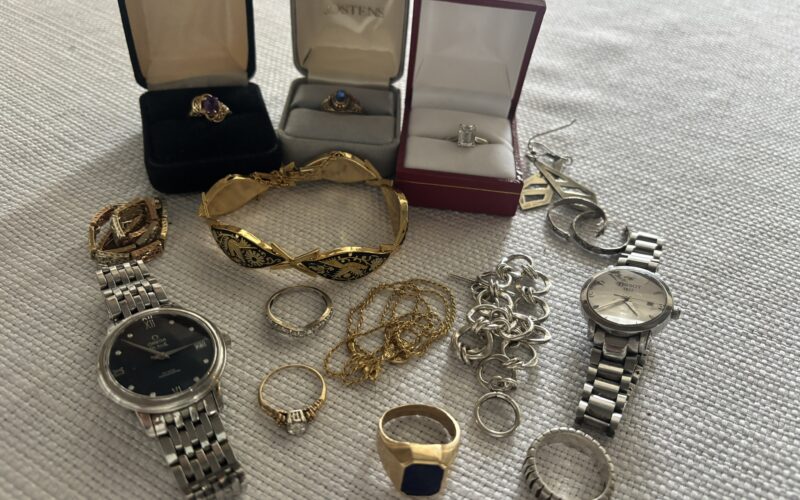
We appraise and deal in collectibles all day long and this tutorial can be used to price the kinds of material we commonly encounter. We provided some hacks for pricing earlier. Here we’ll get more specific about jewelry and fine silver values. People tell us all the time they want to know the “collectible” value of items, not just the “melt” value. The sad truth is, the “spot” (or “melt”) value of coins and jewelry often exceeds actual market value. Dealers have to use the actual “bid” price of metals and factor in market risk and profit. Of course there are exceptions: Tiffany and other names can add value; revolutionary era silver may have a premium.
COSTUME JEWELRY, PEARLS AND FASHION WATCHES
Let’s just get this out of the way. With a few exceptions, most costume jewelry and watches literally trade by the pound. If you have the right Victorian era pin, we’re looking for it. But nonprecious jewelry with common minerals and glass are so abundant that they often fetch a few bucks per freezer bag.
Having said this, we always recommend you bring it all in. Sometimes unmarked gold and gold clasps are present. Certain designers are “hot” and do well on resale. Now why do we have pearls in this section? They are really out of fashion. We’ll take names like “Mikimoto” and “Tiffany” into consideration, but understand that strands of authentic pearls can sell had on eBay for $15-20, and sometimes jewelery buyers clip the gold clasps off to melt. We like giving things a home, and try to sell all our purchases retail or wholesale so they end up with someone who loves them, and not a landfill.
JEWELRY & FINE WATCHES
Styles change, vintage jewelry requires repair, cleaning, and preparation for sale. .999 fine gold reached a record $4,000 in October, 2025, and went higher. When you throw grandma’s charm bracelet on the postal scale, keep this in mind: Gold is measured in troy ounces, not regular (Avoirdupois) ounces; jewelry is not pure, it’s alloyed, and there are ask-buy spreads. We value personal property using prices for physical gold, as opposed to contracts. Consequently, each “ounce” of gold you think you have is worth less than half of that lofty “spot” price in the news. So if you simply toss 14K gold jewelry with clasps, pearls, enamel or minerals on a kitchen scale and multiply the weight by the published spot price of gold, you’ll get numbers over twice what it’s worth. Gemstones don’t count for much unless they are diamonds over half a carat; in fact their estimated weight must be subtracted for calculations.
| The purity of jewelry gold is measured in karats (K), or parts per thousand. An ounce of 14K (or “585”) scrap gold measured on a kitchen or postal scale contains 14÷24×28.5÷31.1 = 0.5 troy ounces of actual gold. With smelting fees this translates to under half an ounce when selling. |
SOME TYPICAL VALUES
- Gold Rings: $100-200.
- Gold Necklaces & bracelets: $250-1,500.
- Cameos, silver & costume: These often trade by the pound but we check everything carefully. Many times we have told customers their unmarked “costume” jewelry actually does have gold!
- Recently we’ve been paying $1-2 per gram for Sterling silver, the highest in the county. It depends on market prices and the nature of the piece. We give consideration to semiprecious stones and designer names.
The above numbers are conservative. We examine markings and test with a modern XRF scanner and acid scratch kit, and may ask permission to cut into heavy pieces. Unlike minted coins, there is little quality control for jewelry production. 14 Karat gold may, upon testing, turn out to be 12K or 15. European silver is often .800 fine, not .925 like Sterling; Mexican silver may be marked 925 but far lower in reality. Clasps, pin and earring backings, enamel, charms, and minerals add nonprecious weight.
Young folks don’t wear watches (I do!), they read the time from their cell phone. The cost of servicing a watch or clock may exceed its cash marketable value. For a watch with a 14K case, the actual gold content is typically only 10-20% of the measured weight. The gold content may exceed market value. Finer brands like Rolex and Patek Philippe may command a premium. A dealer the other day said he’s been selling gold Rolex President models for $2,000 under their melt value; remember that the labor to clean and repair is considerable. Fakes outnumber real ones, even dating back to the day.