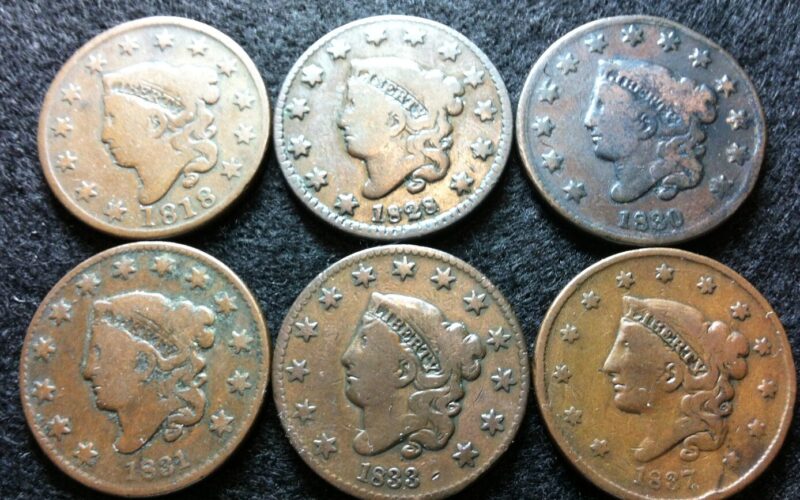
Yeah, this is a long one. But a lot more accurate than much of the nonsense published on the Internet. Are your coins indeed rare? And if so, does that make them they valuable? The large cents pictured above are worth $10-15 apiece retail. Just because they are old and you don’t recognize them doesn’t mean you’ll retire on them. We see Roman coins for which there are fewer than 100 known specimens. How many people can you name that collect Roman coins?
Three generations of hoards are coming to market: The baby boomers/Gen X-ers, their parents, and their grandparents. We get daily calls by people who surfed the Internet or bought a coin app and itemized hundreds or thousands of coins in a spreadsheet, putting them in individual holders worth more than the coins (we sell many in bags and rolls). Talk to us before you do something like that. And don’t clean them or waste time putting them individual holders, many common specimens trade in rolls and bags at shows.
| The marked prices on old purchases is often a useful indication of their current value. If you got it for free, from change, or a tag sale, it was probably common to begin with. If you have auction records or dealer receipts with high valuations, that’s a good sign. Beware of telemarketers, past and present, who sell things overpriced by 2,000% or more. Many of those old Littleton and Franklin Mint purchases are only now approaching their original price tags. |
COINS
There are far more out there than you think; by some estimates, 1,000 have been minted per every person alive on Earth right now. The older ones tend to be more worn and physically may have lost 10-20% of their metal during circulation. We see milk crates of rolls of wheat cents you can’t lift; safe deposit boxes with a million dollars in gold and silver rounds. Loose coins after 1970 are generally worth face value, i.e., your Eisenhower dollars marked “dollar” are worth… drumroll… one dollar. Bicentennial coins were made in great numbers and loose circulated ones have little or no premium. You’ll read a lot about double die errors, Cheerios Sacagawea dollars with special tailfeathers, “close A.M.” cents from 1982. Most of this is nonsense. But never say never, haul it all in, we’ll check your collection carefully.
MINT MARKS
Nothing is potentially more confusing and misleading than the location and meaning of mint marks. You can look up their position on specific issues but it’s the COMBINATION of date and mint that matter. In 1878, CC (Carson City) dollars were the rarest mint. In 1899, no mark (Philadelphia) is rarest. If your coin is missing a mint mark, that does not, in itself, make it an error. The first appearance of “P” on nickels was in 1942, and on cents, in 2017. The 1975 “No-S” dime of great value is the PROOF one from sealed San Francisco government-issued sets, not to be confused with the 586 million regular circulating no-S uncirculated dimes from Philly.
| What follows are typical values for coins in each denomination. We’ll tell you the “key date rarities,” but please understand we never see these in large groups of loose coins. Genuine, high-grade ones purchased from dealers and auctions may be worth hundreds of dollars. Some first-year and key-date issues were legitimately hoarded in large numbers, and surprisingly easy to come by in holders. |
HALF CENTS, TWO CENTS, THREE CENTS, HALF DIMES, 20 CENT PIECES
These archaic 19th-Century issues are popular with collectors.
- Half cents are commonly worth $5-10.
- Two cent pieces, $3-5.
- Three cent silver and nickel coins, and half dimes, $5-10.
- Twenty cent pieces, $25-50 or more.
Those are values for typical circulated specimens. You won’t find ‘em in change, but they do appear in old time collections!
CENTS
- Wheat cents 1909-1958: We buy these in bulk for 2 cents each. “Key dates” (rarities) include 1914-D and early “S” dates (1909-S, 1931-S).
- Indian cents fetch 10-20 cents each in bulk; look for 1877 and 1909-S.
- Flying eagle and large cents, $3-5.
- Most so-called “errors” and varieties are wishful thinking with no premium.
- The 1955 double die is dramatic, it looks like someone wrote the date twice.
Bear in mind most famous rarities and errors have many fake counterparts out there. Old contemporary counterfeits abound, and new ones are made with technologies that fool experts. Most 1914-D cents we see are 1944’s with an altered digit or added mark. 1982 cents, during the changeover year from copper to zinc, come in two weights and seven varieties, all common. Ignore “close A.M.” references to circulated coins. Serious numismatists don’t take them seriously.
NICKELS
- All Jefferson nickels are five cents with the exception of Wartime silver issues – 1942-1945 have a mint mark over Monticello on the reverse and fetch $2.
- Dated liberty and buffalo nickels are about the same as Indian cents, figure 15-20 cents apiece. The dates on Buffalo nickels were high and wore off fast, dateless ones are close to face value. Better circulated dates include 1885, 1886, and 1912-S.
| 90% SILVER CALCULATOR Dimes and higher denominations are 90% silver before 1965. Multiply the face value by half of the current silver spot price to get a rough idea of the cash marketable value for well circulated specimens. E.G., if silver is at $80 per ounce, a 1950s dime yields 80/2 x $0.10 = $4.00; silver quarters, $10; halves, $20; Silver Dollars, $40. This works for post-1981 modern commemorative half dollars and dollars, as well as rolls marked $5, $10, and $20. Half dollars are 40% silver 1965-1970, a low octane alloy the refineries don’t like. Figure these at roughly half 90% silver value, or $5-6 each. |
DIMES
- For silver 90% coins from 1964 and earlier, use the formula above.
- Better dates: 1916-D, 1921, 1921-D, “1942 over 1” error.
- After 1964: spend.
- The 1975 “no-S” dime that’s valuable is only the one in the sealed proof set; there are millions of uncirculated ones from Philly with no mark in change. (To repeat: We don’t find key dates in loose change.)
QUARTERS
- For pre-1965 silver, use above formula.
- Look for 1916, 1918/17 overdate, 1932-D, and 1932-S.
- After 1964: Spend.
- Those gold and platinum plated state quarters have been altered by third party companies, and are just a novelty. Wait, you found a Wisconsin state quarter with an extra leaf by the corn cob? Proud of you! We don’t concede much of a premium to varieties–not because we don’t handle them, but because it usually doesn’t fetch much.
HALF DOLLARS
- For pre-1965 silver, use above formula.
- 1965-1970, they are 40% silver, multiply face value by ⅕ spot ($5-6 each).
- Look for 1916-S, 1921, 1921-D, and 1938-D. 1964 SMS strikes were given to senators, not grandma.
- After 1970: Spend.
DOLLARS
- For pre-1965 silver, use above formula. (I.E., those big ol’ Morgan and Peace Dollars).
- Better date Peace dollars are 1921 and 1928.
- Morgans with a “CC” (Carson City) mint mark under the reverse eagle often fetch $100 or more, with GSA’s starting at $225. We actually see more silver dollars from the 1870s and 1880s than from later decades.
- Peace and Morgan Dollars before 1936 are 90% silver. The silver lobby got the government to make a billion more of those old silver dollars than it needed and many got melted down. In the 1960s they discovered uncirculated bags of them in treasury and bank vaults. The mint sold many “GSA” silver dollars in blue boxes with black holders in the early 70s. Consequently, millions of the silver dollars still in existence are uncirculated. It’s easier to find a turn-of-the-century silver dollar in extra fine than a dime.
- Silver Eisenhower dollars were issued in government packaging only and are $10-12.
- Modern 1970s Eisenhower Dollars and small size dollars after 1978 (Sacagawea, Susan B. Anthony, Presidential, Innovation, etc.) are generally face value (we may offer a little more, they make great tips!). Those gold colored presidential dollars are made of copper and other base metals. The 1800-1900s dates you see are presidential term dates, not when they were actually minted. Adding confusion, some dates appear only on the edge.
- That valuable “Cheerios” Sacagawea? If it’s not still in Cheerios packaging, consider it a dollar.
GOLD COINS
| 90% GOLD CALCULATOR For pre-1933 gold coins and modern commemoratives: Divide spot price by 25 and Multiply by “face” value of the gold. If gold is $5,000, Gold dollars should fetch at least $5,000/25 x 1 = $200; $ 2 ½ “quarter eagles,” $500; $5 “half eagles,” $1,000; $10 eagles, $2,000. $20 double eagles, $4,000. Small denomination gold, $1-$3, are more affordable and may trade higher proportionally than those which are $5 and over. |
FDR made it illegal to hold gold privately in 1933. Not everyone listened, and tons got squirreled away in safe deposit boxes in the U.S. and Europe, only to appear now. Because gold coins have always been precious and it’s an unreactive metal, many were saved after light circulation and look as good as the day they were minted. Worn ones and polished/damaged pieces from jewelry are less desirable.
Many commemoratives were minted and set aside immediately. These often spike in value upon release then invariably drift down to melt value. The most common one we see, interestingly, is the first ever made, the 1892-1893 Columbian Exposition half dollar. 1997-S Jackie Robinson and 2001 Buffalo silver dollars are popular and worth more.
BULLION COINS
Traditional bullion coins (U.S. Eagles, South Africa Krugerrands, Canada Maple Leafs, Chinese Pandas) often have their weight in the design. You can multiply the marked weight (e.g., “¼ ounce”) by the published spot prices. Metals are HIGH right now and there is a negative premium. Since dealers sell these coins at spot, they may offer 90-95%. “Proof” eagles, made with specially polished dies for collectors, can be held in IRAs and have a slight premium if accompanied by original government packaging with papers (“OGP”).
WORLD COINS
The U.S. coin market is strong compared to most world issues. Our mint started operations in the early 1790s, and U.S. coins from that era may sport great value, while their European and Asian counterparts commonly trade for pennies or dollars. Suitcases of foreign coins and paper money came over with immigrants and servicemen over the decades. Many currencies were intensely devalued by periods of hyperinflation and changeover to the Euro and other new types.
World coins literally trade $5-10 to the pound, and less if they’ve been “cherrypicked” for silver and scarcer pieces. We will help you find precious metals and better dates. Sometimes you can exchange paper currency at your bank for a fee. They won’t take foreign coins. World gold and silver spot prices can be found in the NGC World Price Guide. Expect them to fetch $80-90%.
PROOF AND MINT SETS
Proof sets are made from specially polished dies for collectors, they are reflective with mirror-like surfaces. Mint sets simply have uncirculated coins that never got handled. Beautiful, right? Try to find someone who actually wants one. Governments made millions for collectors and many that have not seen the light of day for decades are coming out now. I know dealers who crack out the coins in sets to spend or melt.
- Early ones, from before the mid-1950s, are worth hundreds of dollars.
- Late 1950s to early 1960 silver sets in paper envelopes start at $25-30.
- Boxed proof sets after 1970 can be found in piles in shows for $2-3, with a couple better dates at $5.
- Later ones with special issue quarters and such are often worth more, mostly because they contain so many more coins.
Every decade has some sets with silver, and the silver calculator from above works well for estimating value. We have customers for all of them. We definitely pay more than face value! Condition is important, we consider things like whether they have original government packaging (sometimes we see them in the original registered mail shipping boxes), environmental damage, presence of certificates of authenticity, etc. The first year of issue was 1936, though there exist custom sets put together by dealers and collectors for earlier years. Examples (May 2026, with silver in the $70-80 per-ounce range and gold $4,000-5000):
- 1901: With proof coins including cent through Morgan dollar, $3,000+
- 1950 Proof Set: $350. Often value is compromised by oxidation spots, especially on the cents and nickels, which are more reactive than the higher denomination silver coins.
- 1964 Mint Set: Contains two sets of coins, cent through half dollar. Dimes through half dollar are 90% silver. These retail near their “melt” value, $90-95 with silver at $75/oz. (and gold $4,000-5,000). Dealers often buy them at 50-60%.
- 1966 Special Mint Set: They stopped production of proof sets for a few years during a silver shortage. These contain a 40% silver half dollar. Retail: $15; wholesale, $8.
- 1972 Proof Set: These have five coins, cent through dollar, total face value 91 cents. You’ll see them in the five dollar bin at shows. Dealers typically offer $1.50-2.00.
- 1976 Three-piece bicentennial quarter/half/dollar: These are 40% silver. Retail, $40; wholesale, $25.
- 1995-W Anniversary Set: This one year, the only way to get a proof silver eagle was to buy it in this five piece set, which has 1.85 ounces of gold in the four other coins. Consequently the sets trade in the $8,000-12,000 range.
- 1998 Silver Proof Set: $50 retail wholesale $30.
- 2014 Mint Set: With Philadelphia and Denver, there are a lot of coins in this. They add to $13 and change, and trade near that price.
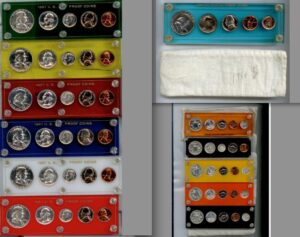
As you can see, it really depends on what’s in them, their scarcity, and market demand. They have a lot of packaging and take up room; most are challenging to sell. Pretty custom Capital Plastics holders notwithstanding (picture above), we actually prefer them in original envelopes and boxes, and sometimes they even trade sealed out of view.
PAPER CURRENCY, STAMPS, LETTERS & BONDS
Most small size currency, like that which we spend now, is close to face value. If you have early notes from the 1920s, or crisp sequential uncirculated notes, they may hold a premium. Some small size currency like national notes, and gold and silver certificates, are more actively sought. These can be identified by different color seals and serial numbers; unlike the green ones we handle daily, they may have blue, red, brown or gold seals. Any tears, pinholes, soling, or folds will compromise value.
“Fancy” serial numbers are popular but need to be really distinctive, for instance, ladder serial 12345678 or solid 44444444 might be worth $100 and up. Radars, e.g., 54122145 are mildly interesting. And star notes? Very misunderstood. Star replacement notes are issued when the original sheets were damaged with ink spills and such. Most are common. There are certainly desirable star notes and lower printings of certain districts, but these usually need to be old (1950s or earlier) to matter, and the value drops quickly with circulation wear. As with coins: don’t try to improve your currency by washing or taping, you’ll just reduce value.
We love world paper but remember much of it is abundant and nearly recyclable. We’ll help assess rarity and condition. In the early 1920s, German inflationary currency became so worthless it was literally cheaper to burn it than to purchase firewood. That should tell you something about how much was made and what it might fetch.
Stamps… if you can use them as postage, you probably should. Generally, stamps have to be old, REAL old, for value. As in before 1900, as in Civil War era. Virtually no one collects stamps anymore. 15 years ago the coin show at Westchester County Center was on the big floor, boasting 125 dealer tables, with 25 dealing in stamps, bonds, stock certificates, postal covers and postcards. The last show was in one room of the Marriott with 12 dealers, and the stamp guy hasn’t been to the last three shows. We did sell a stamp recently for $200. That’s unusual. Uncancelled stamps, in original sheets, can add up; it never hurts to take a look. Stamp collectors, if you can find one, are choosy: The cut has to be perfect, paper bright, glue untouched. They want original specimens slid into an archival window, not hinged or glued to the album. First day covers (dressed up envelopes with canceled stamps) after the 1950s are worth one cent, we use them as envelopes. And world stamps, steamed off the envelopes, are sitting in attics by the crate. We’ll take a look but often advise they be recycled.
ERRORS AND VARIETIES
Error coins, banknotes, and stamps are even more misunderstood than mint marks. Countless social media weenies hawk apps and expensive grading services touting double dies and wrong-planchet strikes. They don’t tell you that the only circulated double die with a significant premium is the 1955 cent, and close A.M., floating roof memorials, Lincoln cracked skulls, and “in cod we trust” designations add virtually nothing to the value of circulated coins. (Notice many of those web “experts” have no contact info, comments, or ratings).
Remember this: Every coin is unique if you look close enough. Errors of value should be dramatic, visible with the naked eye at arm’s length, preferably with no wear. Die cracks and cuds are raised on the surface of the coin, because metal flowed into the die. Scratches and digs cut down into the coin. Significant (5-10%) off-center strikes commonly sell for $10-20. Your double-sided coin is a magician’s prop purchased for $5, not a rare mint error. Multiple strikes are simulated by putting two coins in a vise and squeezing. If the lettering is reversed and depressed (mirror-image), you may be out of luck.
“Missing” mint marks are probably not missing, but just Philadelphia issues of older coins where no mark was placed. A recent freedom of information search by a coin club revealed that all 1986 silver eagles were actually made in San Francisco, though none of them bear an “S.” If you throw around terms like “DDO,” “broadstruck,” “brockage,” and “overdate” shamelessly copied from the Internet, we will come back at you with PMD (“post mint damage”) and LOL.
A NOTE ON DOUBLE DIES: We are getting increasing numbers of questions about doubled obverse and reverse coins. Minor doubling is actually a very common and natural part of the mint’s production process. The very hard dies are struck multiple times and there are hundreds of mint/date combos out there for every denomination that show doubling under magnification. Unless you can see distinct doubling at arms length without magnification, AND the coin is truly uncirculated (from the bank teller, not from change), we are likely to treat your coin as face value. There are just too many out there to hold great value, and you need to filter out eBay asking prices and scams for accurate pricing.
| Clarifying Principle: Dramatic mistakes in production increase the value of a coin or banknote. However, minor flaws and imperfections are common, and render the specimen inferior and decrease the value. Sure, we’ll pay you well for a genuine mule with a nickel obverse and cent reverse. But off-center notes from the 1950s are lower in value than centered ones, not higher. |
Listen: We WANT your “treasure” to be valuable and hope it is. But we also spend a lot of time bringing folks down to Earth after they look up giant numbers on the Internet that turn out to be fantastic asking prices, disguised advertisements, and scams.
Copyright © 2026 Marc Alan Rosner & Hudson Valley Numismatics. All rights reserved.