
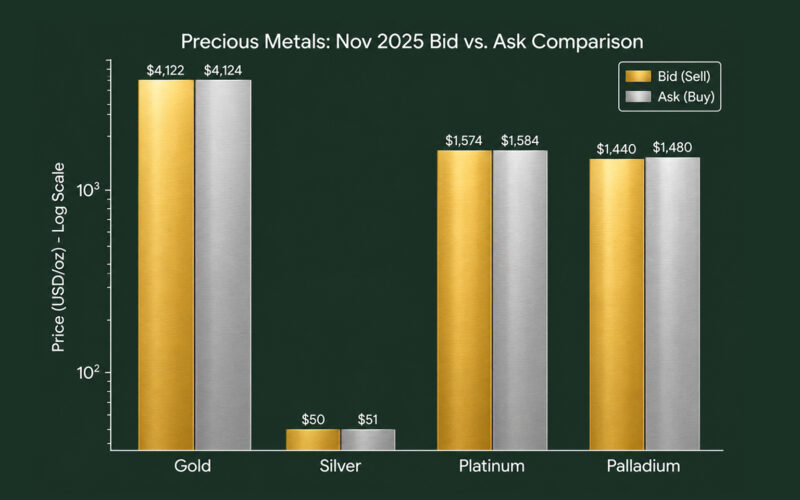
One of the most common questions we hear is:
“If gold and silver are this high… why is the offer lower?”
It’s a fair question—and an important one to understand before selling any coin collection, gold, or silver.
What Is a “Bid Price”?
When you see gold or silver prices in the news, that’s the “spot price.” These widely published prices reflect large corporate contract prices for hundreds of thousands or millions of ounces at a time–not small quantities, and not lesser alloys like 22K or 90% coins; or small deals for one or several pieces. They are subsidized by entities that have an interest in that number being high, as they are selling precious metals, services, or supplies. Spot prices for physical gold, in its various forms, such as those on Fiztrade and KITCO, are lower. The lower the purity of the metal, the less per ounce the precious metals are worth. FURTHERMORE, and this is where most of the confusion comes in, there is an “ask-bid” spread for commodities and investments. That bid is small for liquid investments such as stocks. An internet stock might have an “ask” price–what the seller wants–for $250.00 per share, and a “bid” price, what the buyer is willing to pay, for $249.50. Illiquid things such as couches, cars, and diamond rings may have a huge spread; you know a new car can lose 20% of its value as it goes out the show room, that’s why people pay gap insurance. Buy a new couch for $2,000, and try to sell it for $1,000. Precious metals spreads are in between these extreme examples. A reputable dealer might purchase a 1.85 ounce for a four-piece gold eagle proof set with a theoretical melt value of $9,250 for 97%, or $8,972.59; and hope to sell it for a couple hundred dollars over the melt value at $9,450. And that’s if all goes well; there is market risk, and if gold has a 15% market correction, that dealer is suddenly in the hole for over $1,000. And for everything we just said about gold and silver, the spreads are even greater for more exotic metals like platinum, palladium, and rhodium.
The bid price is what a dealer can actually pay today based on:
- Real market demand
- Refining and processing costs
- Risk and price movement
- The ability to resell the material
That’s the number that matters when you’re selling. There are TWO things that go into that number: the spot or melt price, which is used as a reference; and the premium, which may be positive or negative. When gold and silver were 1/5 of what they are and shooting upwards, everyone was chasing them and dealers could pay a premium over spot and still make a profit. But this is a very different environment; they know that if you had invested in silver and gold in 1980 you would have had to wait DECADES (no exaggeration) to recoup your investment. You can’t eat gold; it doesn’t pay a dividend; it’s buoyed by governments, corporations, and speculators; and there’s plenty in safes, vaults, and the Earth’s crust. Consequently, precious metals prices work in mysterious ways.
Why Offers Are Below Spot
Precious metals are not bought and sold in perfect conditions.
For example:
- Jewelry is not pure gold
- Coins are worn or mixed condition
- Silver alloys vary (90%, 40%, etc.)
- Items must be sorted, tested, and processed
There are also costs involved:
- Refining fees
- Shipping and insurance
- Market fluctuations
Because of this, offers are based on real, tradable value—not theoretical value.
Coins vs. Melt Value
Not everything is priced strictly by metal.
Some coins carry collector value, while others trade strictly for silver or gold content.
- Common coins → priced near melt
- Rare coins → priced based on demand and condition
- Bulk collections → evaluated as a whole
This is where experience matters. We separate what has collectible value from what is simply bullion.
The Reality of Today’s Market
Markets move quickly.
At times, refineries slow down or stop buying altogether. Premiums change. Some materials become harder to process or sell.
We adjust our pricing based on what is actually happening—not outdated numbers or online listings.
What You Can Expect
When you bring in a collection, we:
- Sort and evaluate everything carefully
- Identify anything with added value
- Explain how pricing works
- Present a clear, straightforward offer
No guesswork, no pressure—just accurate information based on the current market.
Final Thought
If you’re thinking about selling coins, gold, or silver, understanding bid prices vs. spot prices is key.
The numbers you see online don’t always reflect reality—but we will.