
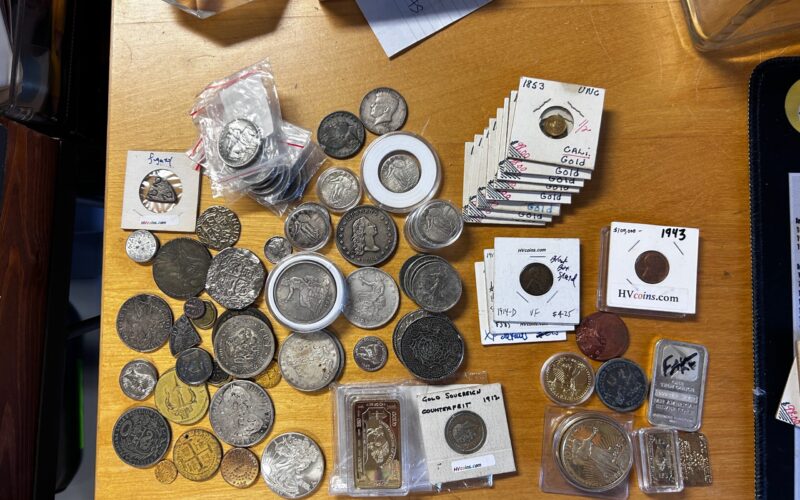
What do you MEAN it’s not real? My dad (or grandpa or uncle or fill in the blank with whichever numismatic genius we should worship) NEVER would have purchased a fake coin!
Look, maybe the dealer who sold it to him didn’t realize it wasn’t real. All I can tell you is I have a dozen diplomas on my wall from coin grading and authentication courses, and spend my days telling folks now what they were going to find out later. I never imagined how many counterfeits I would encounter in this business. There are old copies dating to the day; a half dollar used to be what twenty dollars is now, and it bought lunch. My dad encountered slugs all the time as he checked his silver change for better dates. These tend to be dark in color, with smooth, dull surfaces and a greasy feel. There are new fakes, made with laser die transfer techniques that fool grading companies and the best experts in the field. Some are meant to deceive, imitating real money or rarities. Some were never meant to deceive, but just escaped the context of the museum gift shop. Then there are authentic coins that have been altered to appear rare. Naughty entrepreneurs can restrike a coin with a different design, shave off a mint mark, add one from a different coin, etc. Here we’ll discuss some quick ways even a novice might recognize a “fugazy.” So where to start? (Remember, you never want to clean or alter coins, which can detract from collectible value, so we stick to noninvasive methods.)
- Read the coin or bill, see what it says. Seriously. The Hobby Protection Act of 1973 requires that manufacturers plainly and permanently mark replicas.” Innumerable times, heirs have gotten mad at me for the suggestion their coin wasn’t real, then turned red when I point out the word “COPY” clearly stamped larger than the legend. Now, for this and all rules below: If it PASSES the test and doesn’t say “COPY,” that isn’t a guarantee that it’s real, it just leaves open the possibility.
- Does the coin exist? We see a lot of 1906 Ellis Island dollars that were made out of or in the likeness of 1986 silver commemorative dollars. Everything looks the same: The island buildings, the Statue of Liberty, torch on reverse with rays… but they never made such a coin in 1906. In order for a coin to be genuine, it has to be the right size (diameter and thickness), denomination, weight, and metal. The rim needs to be right: smooth, reeded, or lettered. The date/mint mark combination should be one that exists, with the marks in the proper location. The “Red Book” Guide to United States coins is the authoritative bible on this topic, picturing all coins in real-life size with every date ever made and physical specifications for every issue.
- Check the weight. You’ll need a sensitive electronic or pan balance, preferably one that reads to a tenth or hundredth of a gram; these have become inexpensive. It’s challenging to produce counterfeit coins with the proper size and weight. As silver and gold are relatively dense metals, most fakes of these metals are underweight. We see many Morgan and Peace dollar wannabees that should weigh 26.7 grams but come in at 19 or 20. Again, if it’s the right weight, that’s not a seal of approval, just keeps you in the running. Don’t fall too hard for the “it’s light because it’s worn” theory. Coins have to have a lot of wear to lose a significant amount of their metal. It’s easy to look up the original mass of coins. All 20th Century silver dimes were minted at 2.5 grams; commonly they read 2.3-2.5 on the balance.
- Measure the thickness and diameter. It can help to use a different coin as a reference for comparison. Old large cents vary a lot in diameter, falling between 25-29 mm. But most other coins should have the right size to the millimeter.
- Check the metal. Gold coins should should look gold, it’s an unreactive metal that resists corrosion. Silver coins should look silver or may have toned to a gray or have shades of other colors like blue or brown. Copper is red when freshly produced, then develops an increasingly darker brown patina, and can turn green if corroded. The only U.S. coin that should stick to a magnet is a 1943 cent, when they used zinc plated steel to conserve bronze for artillery. Dealers can verify the metallic content with an XRF gun or electromagnetic Sigma tester. I don’t know why criminals go to the trouble of making fake coins with the wrong metal, but they aren’t all Rhodes scholars.
- Examine the surface quality. Most original coins were struck, sandwiched between two hard metal dies, under great pressure. The metal flows toward the edges and initially the design is sharp, with bold features, and “cartwheel” luster in the background fields. Many fake coins are cast, giving them a duller, grainy, less reflective appearance. The eagle’s feathers aren’t sharp in these, letters tend to be flat. Ask yourself, does this coin look as old as it’s supposed to be? A coin from 1900 should have somewhat uneven wear, with scratches and dings, and dirt or grease hiding in the devices. A newly minted face pretending to be from 1900 tends to be even in color or wear, something new that’s pretending to be old.
- Check the diagnostics. The rarer a coin is, the more likely someone has copied it. The Internet is a great tool for researching the necessary appearance of “key date” coins, the rarest in each series. Experts have blogs posted with photos and arrows. You can compare your coin to authentic ones posted on auction sites in guaranteed holders. The most common fakes I see are 1909-S VDB and 1914-D Lincoln wheat cents, 1916-D dimes, and 1943 copper cents, which should NOT stick to a magnet. There are many guides on the Internet that describe what to look for. Someone might have added a “D” to a 1914 Philadelphia cent; odds are good they did not use the proper font or position. Or perhaps they shaved half an “8” into a “3.” Sloppy work is easy to spot; we study the minute details of real coins as described by experts, and use a loupe or magnifying glass to compare. Here’s a trick I learned from a friend in identifying real 1937-D three-legged buffalo nickels, a famous error coin which is easy to fabricate by, well, removing one leg. I’m just gonna say it: In the authentic error coin, it looks like the buffalo is pissing. Really, you can’t make this up. Every coin is unique upon close inspection, so if you have five 1911-D gold quarter eagles in Very Fine, each with the exact same scratch under the eye, as a past client of mine had, well, really, what are the odds?
- Look for modern security features. Newly minted Federal Reserve Notes have large portraits, microprinting, color-shifting ink in the seal, magnetic intaglio-printed ink with a raised texture, fine blue and read fibers (currency is actually linen, more like cloth than paper) and a security thread. They glow under ultraviolet light.
- Certification through services such as PCGS and NGC is a fairly reliable way to authenticate coins, but can get expensive fast for common ones that are worth less than the cost of “slabbing.” If a coin is already certified, you should check the holder for evidence of tampering. It should be sealed tight, with labels and holograms and other security features supporting what it purports to be. You can look up and verify most coins, and sometimes even find a high-resolution picture of them on the grader’s site if that level of service was chosen. Recently we saw a poorly executed counterfeit of a high grade $10 gold Indian. The coin we had in hand was the wrong color, had significant wear, and had a rotated reverse that even a novice could spot.
- Imagine for a moment it’s fake, and search for it with a browser. A lot of counterfeit Confederate currency notes have the same serial number, a real give-away; serial numbers are, of course, supposed to be unique.
While anything can be faked, some items tend to appear in great numbers. Heavily counterfeited items include early Bust and Seated Dollars, fractional (small) gold-rush era gold coins, key date coins, silver and gold eagles and bars. Famous errors like the 1955 double die abound. And, though this may be a strangely specific thing to guard for, be on the vigilant watch for certain white two-inch square cardboard stapled holders with red and black writing that say “rare” or “uncirculated,” with high prices, dramatic multiple underlining, and explanation points. I have a theory that someone in the late 70s or early 80s rolled out a tremendous number of these, and we see large hoards in multiple pages of three-ring binders brought to us, usually, by someone who had a relative who got scammed at some point and “invested” in them or accepted them as payment.
If you or Gramps have one of these with a tiny round or octagonal gold coin with a bear on it, count yourself in good company; there is at least a 0.1% chance it is real. And by the way, if you are questioning the authenticity of coins you bring us, please be up front and tell. I was rather disenchanted by the guy with the five identical quarter eagles because he was trying to sell them to me, and suspiciously unsurprised and not in the least bit upset when I pointed out they were not real. If you’re curious about the legality of things, It’s not necessarily illegal to alter U.S. coins or currency–companies colorize them and plate them with gold and platinum–but it IS illegal to misrepresent with the intent to defraud. If we do accept your fakes, it’s only to get them off the market. The only destination we have found for them is to hold them permanently as teaching tools.